Indra’s Net and Dōgen’s Sansuikyo
(The Mountains and Waters Sutra)
Fushikusa mo
mienu yukino no
sirasagi wa
ono ga sugatani
mi wo kakusi keri
—Eihei Dōgen (1200–1253)
Winter grasses lie unseen
beneath the snow,
a white heron
hides itself
within its own form
Only an urgent system-wide transformation can avoid climate disaster.
—The United Nations Environment Programme (Emissions Gap Report 2022)
At The Mind & Life Institute we've expanded our mission from promoting "human flourishing" to "flourishing"—of all life, all beings—in recognition of the crucial truth that we flourish with nature—or we don't. Whichever way it goes, we go together. We're part of nature, inseparable, and too many people seem to have forgotten this interdependence.
—Susan Bauer-Wu, A Future We Can Love: Inspired by the conversation between His Holiness The Dalai Lama & Greta Thunberg
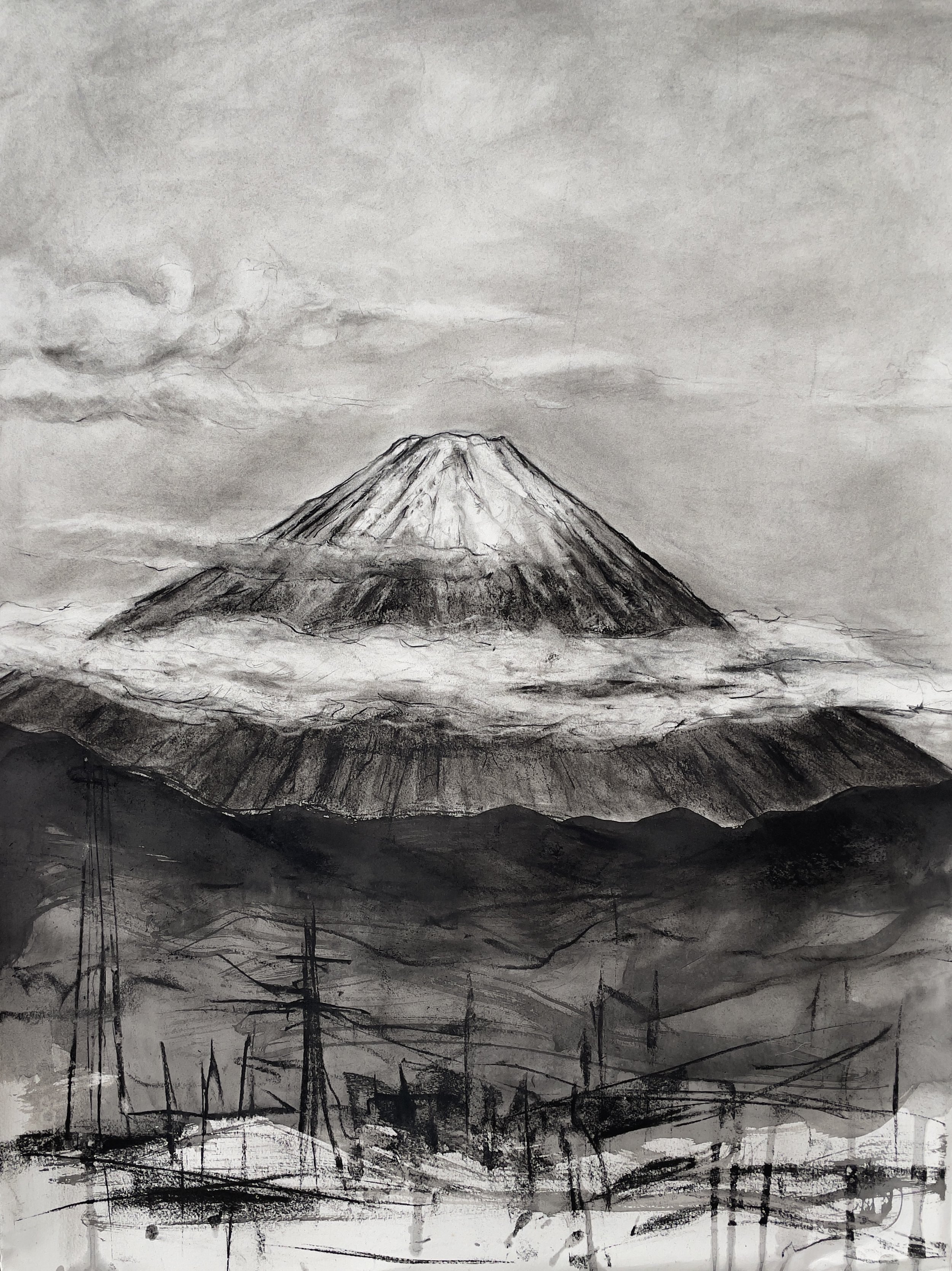
Indra’s Net (Indrajāla*) is a rich metaphor articulating the interconnectedness and dependent origination of all things living and nonliving. “I believe a leaf of grass is no less than the journey-work of the stars," wrote Walt Whitman, much in the spirit of interdependence and in seeing the whole cosmos in seemingly familiar objects. In my ongoing drawing collection, Indra’s Net, I seek to observe and feel such intermeshing of objects and forces—the sea and rocks, the winds and trees, the ecological landscape, myself, other beings—as mutually dependent and inextricably entwined. Indeed, as in quantum field theory, there is no clear definition of matter, energy, or forces except through the observation and understanding of their properties and interactions. “I” am as much defined by the microbiome on and within “my” body and the external ecosystem in which we coexist, as by any illusory sensation of a linearly persisting and uniquely existing self.
Letting go of this illusion of self while also recognizing its persistence, I feel more at one with the world and its impermanence. Living at the Wildland-Urban interface and experiencing constant reminders of change—of wildfires, earthquakes, the slow grind of the Pacific and North American plates (that will, in 15 million years, bring Los Angeles north to abut San Francisco), human encroachment into wilderness, climate change, watersheds, wildlife, and community responsibility (I must, ethically and legally, manage dry brush on our modest ranch to mitigate the dangers of fire)—I feel the weight and the raw wonder and beauty of this world and the imperative to live mindfully and well. These drawings emerged from such observations and from lived somaesthetic experience. The power of the indifferent surf when swimming in Malibu, the awareness of other beings watching me on the hiking trails—mountain lions, coyotes, rats, quail, hawks, bobcats, foxes, mule deer, desert hares, vultures, and rattlesnakes—the harsh realities of the powerful Santa Ana winds drying out the Southern California landscape coupled with intense heat and drought, exposing it to fire and spreading smoke that lodges deep in the lungs. The fire-cleared brush later leaves the dirt vulnerable to massive mudslides when the storms come, further altering the landscape. The changes can be devastating and profound and certainly inescapable. If we humans are to live here in Southern California we must respectfully understand the whole environment and not merely our desired participation and residency in it.
There is beauty in this. Our species evolved to experience awe and fear and delight in such a place. The forces of nature and change and seeing the world—the mountains and waters—as it is, complete and symbolic of nothing, is to experience interconnectedness directly, much as Dōgen—the 13th century founder of the Sōtō school of Zen Buddhism in Japan—understood the mountains and waters through endless walking meditation. Hiking near and far from home, exchanges of essential nutrients between trees and other plants via roots and mycelial networks, and, through my own inhalations and exhalations and those of the trees, swapping gases and chemicals—shinrin-yoku—or just being in the clarifying desert or ocean… nourishes the mind. And body.
I experience it in the studio as well. The somatic embodiment of gesture and mark-making, painting… the buildup of material surface… the geology and excavation involved in painting and drawing… pentimenti, non finito… creation, destruction, evolution, wonder, change… and vastness. Just as a skilled and experienced violinist unconsciously presses down, draws, and eases up with the bow in a full, physically engaged sensitivity to the emotional potency of sound, the artist presses, lifts, and draws the charcoal—itself a product of fire—across and into the page in a visually traced re-experiencing of the act of touch, and awareness of the profound and penetrating forces of nature.
—Daniel Barber
*Indrajäla. (T. Dbang po'i dra ba; C. Yintuoluo wang/Di-Shi wang; J. Indaramo/Taishakumö; K. Indara mang/Che-Sokmang 因陀羅網/帝釋網. In Sanskrit, “Indra's net”; a metaphor used widely in the Huayan Zong of East Asian Buddhism to describe the multivalent web of interconnections in which all beings are enmeshed. As depicted in the, Avatamsakasütra, the central scripture of the Huayan school, above the palace of Indra, the king of the gods, is spread an infinitely vast, bejeweled net. At each of the infinite numbers of knots in the net is tied a jewel that itself has an infinite number of facets. A person looking at any single one of the jewels on this net would thus see reflected in its infinite facets not only everything in the cosmos but also an infinite number of other jewels, themselves also reflecting everything in the cosmos; thus, every jewel in this vast net is simultaneously reflecting, and being reflected by, an infinite number of other jewels. This metaphor of infinite, mutually reflecting jewels is employed to help convey how all things in existence are defined by their interconnection with all other things, but without losing their own independent identity in the process. The metaphor of Indra's net thus offers a profound vision of the universe, in which all things are mutually interelated to all other things, in simultaneous mutual identity and mutual intercausality. The meditation on Indra's net (C. Diwang guan; J. Taimo kan; K. Chemang kwan) is the last of the six contemplations outlined by Fazang in his Xiu Huayan aozhi wangjin huanyuan guan ("Cultivation of the Inner Meaning of Huayan: The Contemplations That End Delusion and Return to the Source"), which helps the student to visualize the Dharmadhatu of the unimpeded interpretation between phenomenon and phenomena (Shishi Wai Fajie).
Buswell, Robert E., Jr., and Donald S. Lopez Jr. The Princeton Dictionary of Buddhism. Princeton: Princeton University Press, 2014, p. 372.